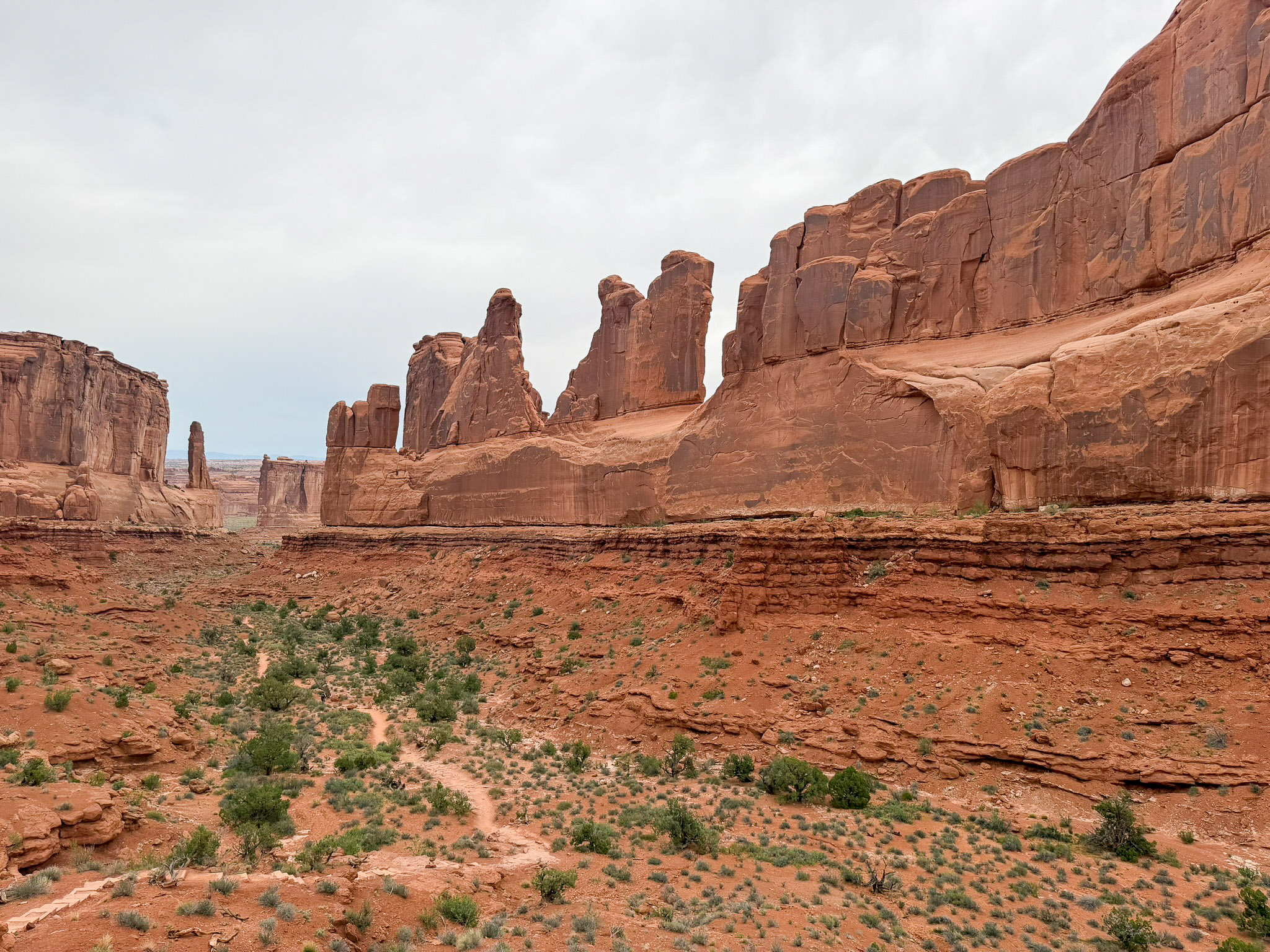
Arches National Park
76,000 acres of eroded sandstone fins, balanced rocks, and the highest concentration of natural arches on earth.
Our Take
Of all of the National Parks, Arches provides the best single day experience of any park in the system. Unlike other small parks you can explore in a day but feel underwhelmed by (hello, Hot Springs), Arches provides an enormous amount of visual “bang” for the buck for such a compact park. There’s a great scenic drive that gets you easy access to each distinct area of the park, and with only 17 miles of official trails all of Arches’ key geological features such as the Windows, Double Arch, Landscape Arch, Park Avenue, Balanced Rock, and more are on relatively short trails. Even the “longer” trails such as Delicate Arch and the more distant arches in Devils Garden are still more on the “moderate” than strenuous side at least compared to other parks. Assuming you get an early start, you can experience a ton of the park in a day. We still recommend spending far more than a day in the area, however, so you can experience other amazing places nearby.
The key thing for a successful trip in Arches is planning around and for the heat. Visit in Spring or Fall if you can, and plan your longer hikes for cooler mornings whenever possible. We like to do the longer, more strenuous hikes like Delicate Arch and Devil’s Garden first thing in the morning (if you do Delicate Arch at sunrise you can still get into the Devil’s Garden parking lot by 8-8:30am, which is what we did), take a long break around lunch time to avoid hiking during peak heat, and then hit smaller shorter trails like Windows and Park Avenue in the afternoon. This naturally gives you a short break in your car’s AC between each of these smaller trails as you drive between them, and you can keep doing smaller overlooks and trails until you feel satisfied and ready to return to the comfort of your hotel or RV.
Things to Do in Arches National Park
Hike Delicate Arch
▼
Hike Devil's Garden
▼
Explore The Windows
▼
Explore Park Avenue
▼
Take A Jeep Tour
▼
Visit Mill Canyon Dinosaur Track Site
▼
Potash Road Scenic Drive
▼
Hike Corona Arch
▼
Visit Canyonlands National Park
▼
Visit Dead Horse State Park
▼
Tips for Visiting Arches National Park
No Timed Entry In 2026
Pack A Lunch – There's No Food In Arches National Park
Stay Hydrated
Start Your Day Early
Take A Break 11am-2pm
Consider a Sunrise Start for Delicate Arch
Best Time to Visit Arches National Park
Unlike mountain parks that are still snowed in by May, the ‘shoulder’ season in early spring is the best time to visit Arches National Park. The temperatures are moderate, and you avoid the peak heat and crowds that settle in by late May and June. Fall is another wonderful time to visit the park for similar reasons, but if you’re planning a road trip to visit other Utah parks such as Zion or Capitol Reef, we recommend visiting in spring so you’re able to see the best wildflowers and bright green river growth in those parks.
If you have school age children, this makes for a great Spring Break trip, but keep in mind that Utah residents will have a similar idea and the parks will feel a little more crowded that week. While we have seen recommendations to avoid Moab during the Moab Easter Jeep Safari, our last trip overlapped with the event and while it was a bit busier it was by no means miserable. If your dates are fully flexible, it can be better to avoid the event due to increased hotel prices, but if this is the only time you can visit Arches it won’t ruin your trip. If you ever feel too crowded, pop over to Canyonlands National Park, Dead Horse State Park, Potash Road, or the Mill Creek dinosaur sites, and you’ll find a bit more quiet.
Average Park Visitors by Month
Temperature by Month
Getting to Arches National Park
Visitor Centers
Arches Visitor Center
Entrances
Main Entrance (US-191)
Entrance Fees
Where to Stay
Gateway Towns
Moab Our Pick
Green River
Frequently Asked Questions
What Are the Hours for Arches National Park?
Arches National Park is open 24/7 all year round, though some services like the Visitor Center will have more limited hours.
Does Arches Require a Timed Entry Reservation?
No, Arches National Park is not using a Timed Entry system in 2026, though it has used one in the past. To avoid getting stuck in a long entry line, we recommend arriving before 8am or after 3pm during peak season.
Can I do Arches National Park in a Day?
Arches is a fairly compact park, and you can get a great experience from the park in a day, but you need to start early and make some trade offs on what you will and what you won't see. What we wouldn’t recommend is trying to do both Arches and Canyonlands in a day, unless you are only planning to do the scenic drives and overlooks.
Is there Lodging in the Park?
Devils Garden Campground is the only place to stay within the park. The campground takes reservations from March through October but is open on a first-come first-served basis November through February. During the March to October season the campground is typically full every night, so reservations are highly recommended (or you’re most likely going to be turned away).
What's the hiking like in Arches?
Unlike Yosemite, Yellowstone, or Glacier where you may find a dozen or more 8-15 mile trails with thousands of feet of elevation gain, Arches is more of a collection of smaller hikes that you can stitch together. This is actually great given the high temperatures most months, because it means you can create a packed itinerary of smaller hikes but never be too far from your car if you find the heat takes a bigger toll on you than expected.
Is Delicate Arch Safe For Kids?
Yes, with the ability to closely supervise and hold hands. The hike is very safe during the first 2/3rds of the hike, where you are hiking across juniper flats and up the long stretch of slickrock at the midpoint - just don't let them completely run off on their own and make sure you always know what's ahead of them, but unless they're way off trail the drops are small. You'll know immediately when you reach the point where it becomes a bit riskier, because the wide slickrock trail will suddenly turn into a 3' wide path going around the bend with a steep drop off. Here's where you'll want to hold hands with younger children (the path is wide enough for one parent and one child easily), and works best if you have a 1 adult to 1 child ratio in your group. You also won't want kids playing around the slickrock around Delicate Arch, as there are a lot of points where children and adults could slip, so we use this as a good spot to sit down and have some skittles or a small sandwich to distract them but keep them anchored in one spot. Heat stroke and dehydration are the far larger risk on this hike, so just take your time and carry water.
What's the Parking Like in Arches?
Get to Delicate Arch before 8am, and Devil's Garden before 9am (the earlier the better). These two spots are incredibly popular in peak season and fill up fast. Sunset is even more popular at Delicate Arch, but it at least has the benefit of people coming off the trail and leaving so spots open slowly and you can USUALLY find a spot though that's not a guarantee - arrive a couple hours early so you don't feel rushed. The Sand Dune Arch Lot can also fill up at mid-day from travelers taking a break in the shade of the arch during the hottest part of the day.
Can I drive through Arches National Park?
Arches' scenic drive is a 36-mile round trip from the entrance station to Devil's Garden and back, and there is no way to exit the park by car without turning back around and heading out the entrance. It's a gorgeous scenic drive, though. Allow 3-5 hours if you want to fully explore the drive, offshoots, overlooks, and tiny trails to view points.
Are Dogs Allowed in Arches National Park?
Yes, but only in limited locations: along established roads, parking areas, campgrounds, and picnic areas. Pets must be attended at all times, and cannot be left in a vehicle when there's risk to the animal (you really don't want your pups in the car at this park, it gets real hot real fast). Established roads include dirt roads, though! Check out Cache Valley Road, which starts at the Lower Delicate Arch Viewpoint, but make sure you have a downloaded map if you're headed more than a couple miles so you can find your way back when the road starts to fork.
How can I do Fiery Furnace?
Fiery Furnace is a challenging loop trail through a maze-like collection of sandstone formations, and can only be done by applying for an individual permit for $10 per person or making reservations for a ranger-led tour spring through fall for $16 a person. Reservations for the ranger tour can book out months in advance, so if this is high on your list be sure to reserve your spots well ahead of time. Children under five are not allowed on either hike. GPS units do not work well within the Fiery Furnace, and it can be very difficult to navigate, so we do recommend the ranger-led tour over individual permits.
If you could only do one hike in Arches, what would it be?
Corona Arch. 🙂 Okay, more seriously, Delicate Arch. It's an icon for a reason, and it's hard to explain just how stunning it is to see in person, especially at sunrise or sunset when the reds, blues, and greens of the surrounding landscape stand out like something out of a fine painting.