Zion National Park
UT · National Parks

Zion National Park

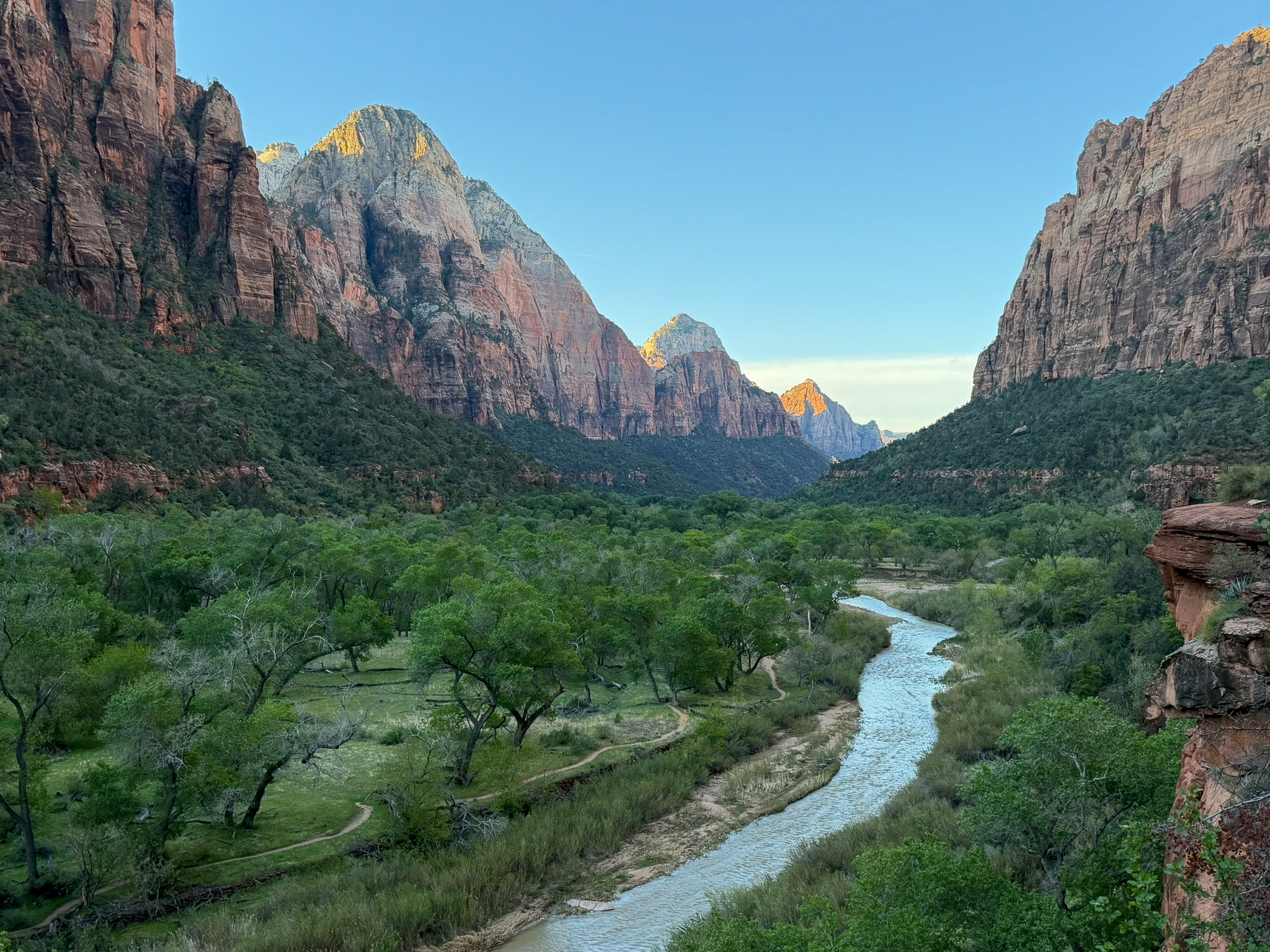
Towering sandstone cliffs of cream, pink, and red soar into a brilliant blue sky above the Virgin River's ancient canyon, carved over millions of years.

2000' Canyon depth
90+ Miles of Trail
148k Acres
1919 Year Established

Our Take

Zion National Park is the first park Dustin and I ever visited together, and it was an unexpected add-on to a trip that led me to discover one of my favorite national parks. We were in Vegas for a music festival, and logistics that year were an absolute mess — the first night it took us three hours to get from Vegas to the race track only 18 miles away where the festival was held, causing us to miss several sets, and then after an amazing evening of dancing and fun it took us another four hours to get back to our hotel. When we woke up that afternoon, we realized we didn't want to go through those drives again, and we bailed on the rest of the festival to visit Zion.

Maybe it was the stark contrast of going from the festival crush and lights to the quiet peace of early hiking, but Zion felt like another world to me. This was early on in my park expeditions and I had no idea what to expect, but Zion just blew me away. The canyon feels intimate, with towering walls of red, orange, and pink on either side of you, and the bright green of the cottonwoods and river trees standing out. We stayed in Springdale, and my first experience in the park was riding the bus all the way back to the Temple of Sinawava to do the Narrows, and then hitting up Angel's Landing the next day (this was back before permits were required). Then we headed out on the Zion-Mt Carmel highway on our way to Bryce, and it just cemented Zion permanently as one of my favorite places in the US.

We visited again in March 2026 to take our son for the first time, and it was a different but still magical experience as a family. We rented E-bikes, including a wagon for the camera gear (and Warren when he needed a break from the wind chill), and it was hands down the best way to experience the park. Unlike the bus where you can spend a lot of time waiting in line, and you’re limited in your ability to really take in the canyon during the bus drive itself, e-bikes give you the ability to explore the entire park at your own pace and take in the whole view. Because the canyon road is open only to buses, it’s also incredibly safe.

One thing we did notice on our trip this year is just how busy Springdale has gotten. New restaurants and hotels are springing up like weeds, and unfortunately so are the prices. (Dustin is still commenting on the $6 Gatorades in the grocery store.) This can bring new favorites like Anu, one of the best meals we had on our Utah Mighty Five road trip, but with only one main thoroughfare through the town it’s definitely started to feel a bit congested in town. Once you get in the park, however, it’s still the same stunning Zion and the crowds spread out a bit more after you get past the first couple of stops.

Things to Do in Zion National Park

The Narrows

Take the bus to the last stop at Temple of Sinawava, take the Riverside Walk back, and then wade upstream through the Virgin River between towering 2,000-foot canyon walls in one of the world's most unique hiking experiences. Water ranges from ankle to waist-deep (sometimes chest-deep during spring runoff), and many local outfitters are available to rent gear from to keep you warm and dry. Hiking sticks are a must for keeping your footing in The Narrows, and cameras and other sensitive equipment should be kept in a dry bag just in case you take a spill.

Angel's Landing

Utah's most iconic hike takes you 5.4 miles round trip with 1,500 feet of elevation gain to a knife-edge summit offering panoramic views of Zion Canyon. The final half-mile involves holding chains bolted into the rock spine, and is not for the faint of heart. Permits are now required to do this hike past Scout Lookout—apply months in advance or try the day-before lottery. Can't get a permit? Scout Lookout and viewpoints further along the West Rim Trail are still stunning, or check out the eastern trail into Observation Point.

Rent An E-Bike

Rent an e-bike in Springdale and ride the Pa'rus Trail to explore Zion Canyon Scenic Drive, bypassing shuttle lines while cruising beneath towering sandstone cliffs. Stop at any trailhead or viewpoint along the 8-mile route to the Temple of Sinawava, then coast back downhill. This is one of the best ways to experience the park and frees you from shuttle wait times. Some rental outfitters like Zion Peddler will let you arrange for early pickup, which can be great for hikers who want to get started well before the shuttle start time of 7am.

Zion-Mt. Carmel Scenic Drive

This stunning scenic drive climbs through dramatic switchbacks, passes through the historic 1.1-mile Zion-Mt. Carmel Tunnel (completed in 1930), and showcases unique geological features like Checkerboard Mesa and the Great Arch. Pull off at numerous viewpoints to take in sweeping vistas of slickrock formations and seasonal waterfalls.

Emerald Pools

Access these hanging garden oases via the Emerald Pools or Kayenta Trails. The Lower, Middle, and Upper Emerald Pools offer a family-friendly hiking option with waterfalls, shaded alcoves, and lush vegetation fed by seeping groundwater through the Navajo Sandstone. Our favorite way to do this trail is as a loop starting at Zion Lodge, walking the Grotto Trail, taking the Kayenta Trail up to the pools, and then taking the Emerald Pools trail back to the lodge. The scenery of the river and canyon from the Kayenta Trail is stunning as the sun rises and lights the canyon walls.

Canyon Overlook

Start this 1-mile round trip hike just east of the Zion-Mt. Carmel Tunnel before dawn to catch sunrise illuminating Zion Canyon from above. After the initial climb up a series of stairs carved into the rock, it flattens out as the trail hugs the canyon wall and becomes a relatively easy walk. This trail has some great points of interest as you pass small overlooks, go around the cliff wall on a wooden bridge bolted into the canyon, through a mossy cave, and then curl around slick rocks to make your way to the main overlook.

Kolob Canyons

Drive the scenic 5-mile Kolob Canyons Road (separate entrance off I-15, Exit 40) for stunning red rock vistas without the Zion Canyon crowds. There are hikes for all difficulty levels in this area, from the easy 1.2 Timber Creek Overlook trail that's great for both adults and kids, to strenuous hikes like the 14-mile roundtrip to Kolob Arch, the second longest arch in the world by three feet.

The Subway

One of Zion's most coveted permits, this challenging 9-mile route through the Left Fork of North Creek features a stunning subway-shaped slot canyon with sculpted walls, pools, and waterfalls. There is no formal trail on this hike, and you'll be spending most of your time wet as you navigate in and out of the creek all day, but the payoff is solitude and stunning photography.

Tips for Visiting Zion National Park

1

Expect To Ride The Shuttle

Zion Canyon Scenic Drive is closed to private vehicles from early March through late November when the free shuttle operates every 5-10 minutes with the first bus into the park departing the visitor center at 7am. Visitors staying at Zion Lodge can drive into the canyon as far as the lodge but must park and ride from there. Be prepared for a wait at the Visitor Center, Zion Lodge, and the Temple of Sinawava as these lines can get backed up on peak days, but other parts of the park will be quieter as visitors disperse.
2

Make E-Bike Reservations Early if Traveling With Kids

While Zion Outfitter is the go-to bike rental place for many given it's directly at the pedestrian entrance to Zion, there are numerous places to rent from. However, if you're trying to rent a "Radwagon" where kids ride on the back, a pull-behind Burly wagon, or kids’ bikes, you'll want to make reservations a couple months in advance. We rented our gear from Zion Peddler after a last minute panic the week before trying to find a place that still had Rad Wagons available, and we saw several families turned away the day of our ride because they were fully booked out of these types of bikes even though they had a lot of adult bikes still in stock.
3

Angels Landing Requires a Permit

Since 2022, permits are required to hike beyond Scout Lookout onto Angel's Landing. You can apply via seasonal lottery for dates in advance, or apply by 3PM the day before to enter the lottery to hike the next day. If selected in the lottery you'll receive an e-mail confirmation, and this acts as your permit so you must print, download, or screenshot this e-mail prior to your hike. Don't get turned away because of bad cell service. The permit is only required for Angel's Landing itself, so if you don't get selected you can still hike up to Scout Lookout and further along the West Rim trail for some phenomenal views that rival (and some might argue are better) than Angel's Landing.
4

Check For Flash Flood Risks Before Hiking The Narrows

The Narrows closes when the Virgin River exceeds 150 Cubic Feet per Second or flash flood warnings are issued. You can check in on the state of the water at the Visitor Center before your hike, or check the US Geological Survey page for flow rate information. Never hike the Narrows (or any slot canyon) with rain in the forecast, and be especially vigilant mid-July through mid-September when the area receives a lot of thunderstorms.
5

Be Aware of Major Closures

While Weeping Rock Trail reopened in September 2025, Hidden Canyon and East Rim Trail to Observation Point remain closed indefinitely due to rockfall that destroyed large portions of the trail. However, Observation Point is still accessible if you hike in from the east via the East Mesa Trail, roughly a 40-minute drive from the visitor center. The road to the trailhead can be rough at times, and the lot only allows for about 8 cars, but you can also reserve a hiking shuttle from the Zion Ponderosa lodge on the eastern side of the park if you're not sure you can make the drive.
6

Canyon Overlook’s Parking Lot Fills 45 Minutes Before Sunrise

Right on the other side of the mile-long Zion-Mount Carmel tunnel is a tiny parking lot for the most popular trail outside the canyon, Canyon Overlook. This parking lot only has 10 spots, one of which is handicap, and when we slid into our parking spot an hour before dawn we were #7 and the other two remaining spots filled within minutes. And it doesn't get any quieter since it's on the main thoroughfare into Zion from the east, so expect a little bit of chaos in this area as visitors walk from where they've parked along the road to access the trailhead.

Best Time to Visit Zion National Park

Our pick: April-June, Sept-Nov.

As the second most visited US National Park, Zion is often busy, but we love visiting the park in April – early June to get the best, most well-rounded experience. While Winter is quieter and peaceful, ice makes popular hikes like Emerald Pools and Angel’s Landing treacherous, and The Narrows a very cold and unpleasant experience. By April, temperatures will be cold in the morning but rapidly warm up in the afternoon, providing for great hiking, tons of spring flowers and budding trees, and interesting encounters with turkeys in full display as they try to find their spring mates. But if The Narrows is the top item on your bucket list, you'll want to aim for mid-May through June, so the river isn't quite so cold and there's less chance of closures. Summer temperatures in Zion can be brutal, with July topping 100F on average, and frequent thunderstorms July-August, so it tends to be the worst season in terms of crowds and weather. September-November can be another great time to visit as things begin to cool down again.

Average Park Visitors by Month

Temperature by Month

Cold (< 55°F)
Ideal (55-80°F)
Hot (> 80°F)
Average

Getting to Zion National Park

Visitor Centers

Zion Canyon Visitor Center

Located near the South Entrance just at the edge of Springdale, this is the main visitor center where most visitors begin their trip. It features ranger staff, outdoor exhibits, wilderness permits, the Zion Forever Project bookstore, restrooms, picnic areas, water bottle filling stations, and serves as Shuttle Stop #1 for both the Zion Canyon and Springdale shuttle lines. This is where you'll find park information, maps, and can arrange permits for backcountry trips and canyoneering routes.

Kolob Canyons Visitor Center

Located at the Kolob Canyons entrance off I-15 (Exit 40), about 40 miles from the main Zion Canyon area. This is a much smaller and less crowded visitor center, and features a few small exhibits on the area's history, geology, and pioneers who shaped the region. This visitor center also serves as the entrance station for this section of the park, and they'll ask you to stop by and show and/or purchase your park pass on the way in.

Entrances

1

South Entrance (UT-9 from Springdale)

The most popular entrance located just outside Springdale, providing access to the main visitor center and shuttle system into Zion Canyon. You'll need to pass through this entrance if you are just passing through the area on the scenic Zion-Mt Carmel drive. This area can get congested, including with visitors on bikes heading between their rental outfitter and the park, so be prepared for a slight backup here.
2

East Entrance (UT-9 from Mount Carmel Junction)

Numerous visitors pass through East Entrance on their way in and out of Zion to places like Bryce Canyon, Page, the Grand Canyon, or Monument Valley. This entrance is subject to vehicle size restrictions as it passes through the Carmel tunnel, and passes scenic spots like the Checkerboard Mesa, Canyon Overlook's trailhead, and numerous unmarked spots leading to quieter trails not managed by the park itself.
3

Kolob Canyons Entrance (I-15 Exit 40)

40 miles north of Zion Canyon on I-15 is the entrance to Kolob Canyons, a separate and distinct section of the park that is quieter and less visited than the main canyon and allows cars on its scenic drive. This section does not connect with the main Zion Canyon, and is only used to access the Kolob Canyons section of the park.
4

Kolob Terrace Road (from Virgin, UT)

The most remote part of the park, Kolob Terrace, can be found about 15 miles west of Springdale on UT-9 by turning onto the Kolob Terrace Road. Here the road climbs 3,900 feet to over 8,000 feet at Lava Point, passing through the park's high country on the way. There's no formal entrance station or visitor center here (and no real services to speak of), and the road doesn't connect to any other part of the park. This section is primarily used by hikers accessing The Subway, West Rim Trail, and other backcountry routes. This section of the park requires coming in with a plan, a map, and general hiking experience as it is much more rustic and less maintained than other areas in Zion.

Entrance Fees

Car
$35
Motorcycle
$30
Person
$20
Zion Annual Pass
$70

Where to Stay

Lodges Inside the Park

Gateway Towns

1
mi south

Springdale Our Pick

Springdale sits right outside the main entrance to Zion, and is a thriving hub of hotels, outfitters, restaurants, and shops. With a shuttle running through the town's main street leading into Zion, it's incredibly easy to get from your hotel around the town and then into the park itself. The downside is Springdale is popular, and that popularity has caused a hike in prices. (In fact, this last trip we found it more cost effective to stay in a suite in Zion Lodge itself.) If you're looking for budget hotels, you'll need to look further afield in La Verkin and Hurricane, but if you avoid peak times and book ahead you'll still find chains like the Best Western and smaller B&Bs that offer a solid stay without the luxury resort price point. We have a soft spot for Springdale, so we still prefer it as our landing spot, but even we are starting to question the value of staying in town.
Best for: Convenient access to Zion Canyon, first time visitors, great food, and shuttle transportation through town and into the park.
18
mi east

Orderville

After you head out of the eastern Zion entrance, you'll eventually come to a fork in the road where north will take you towards Orderville and south will take you towards Kanab. On the stretch between Zion and Orderville you'll find a ton of lesser known lodging options like the Ponderosa resort which offers great access to the east side trails (including the only way to now get to Observation Point), hotels with significantly lower price points than Springdale, and lots of little cabin and glamping stays. If you're looking for something a little more rustic and quiet, this is it. They're currently working on a new regional Discovery Center for Zion in this area that plans to open soon.
Best for: Quiet resorts and cabin options, easy access to the less-traveled eastern trail heads, canyoneering routes.
22
mi west

La Verkin

Right on the route between Zion Canyon and Kolob Canyon, you'll pass through La Verkin, a small town with several new chain hotels from Best Western, La Quinta, and Holiday Inn at the main junction. While it will take you 25-30 minutes to get to the South Entrance, Springdale's growth has made this a much more affordable town to stay and eat in, and places you in a good position if you also want to spend more time in Kolob Canyon or make a side trip to Cedar Breaks National Monument. It can also be much easier to find hotels here after Springdale books up.
Best for: Budget travelers or large groups looking to stretch their dollar, glamping, and easier access to Kolob Canyon and Cedar Breaks National Monument.

Frequently Asked Questions

Is Zion open all year round?

+

Yes, Zion is open year-round. However, Kolob Terrace Road closes in winter due to snow, and upper sections may remain closed into late spring. Kolob Canyon can also occasionally close due to snow. Check current road conditions at the visitor center or nps.gov/zion before visiting these areas.

How many days should I plan to spend in Zion?

+

Two to three full days in the park is ideal. One day lets you hit one major hike (Angels Landing, The Narrows, Observation Point), but three days gives you time to fully explore Zion Canyon, the Zion-Mt. Carmel Highway area, and Kolob Canyons without feeling rushed.

If you're not a hiker, we still recommend a full day in the park so you have time to explore Zion Canyon on the shuttle and get out at each stop. If you're visiting when the road is open to vehicles, you may be able to pack all the scenic drives into a single day, but it's worth staying overnight to experience sunset and sunrise colors against the cliffs.

Are the Zion Shuttles free?

+

Yes, the Zion Shuttles are free and do not require a ticket or reservation. The Zion Canyon Shuttle is just inside the park, however, so expect to pay an entrance fee or show your park pass before you reach the shuttle itself.

Are pets allowed in Zion National Park?

+

Yes, but only in very limited areas. The Pa'rus trail at the visitor center is the only trail which allows pets (but at busy times this may not be very enjoyable due to the number of cyclists also using this trail to enter the park). Pets can be in parking areas, developed campgrounds, picnic areas, and on the grounds of Zion Lodge (outside the hotel). However, they cannot ride the shuttle, enter public buildings, or go on any of the trails or wilderness areas.

Can I drive to the lodge if I'm staying there?

+

Yes, lodge guests receive a red parking permit and gate code allowing them to drive up to the Zion Lodge parking lot. However, you cannot drive beyond the lodge on Zion Canyon Scenic Drive.

What types of bikes/e-bikes are allowed in the park?

+

Only Class 1 e-bikes (pedal-assist, no throttle, max 20 mph) are allowed on park roads and the Pa'rus Trail. Class 2 and 3 e-bikes with throttles are considered motor vehicles and prohibited. Regular bicycles are also allowed on these same routes and can be placed on the shuttle racks for transport if you want to shuttle to Temple of Sinawava and ride back down instead of doing it as an out-and-back.

When is the best time to see the waterfalls at Emerald Pools?

+

Visit in spring during snowmelt or just after heavy rainstorms. The waterfalls often slow to a trickle or dry up completely during summer and fall, so it's best to make a point to head to the trail the day after a storm if you're lucky enough to have one. Check recent trail reports or ask rangers about current water flow before hiking, or you can ask hikers on their way out if you're visiting later in the day.

Would you recommend The Narrows with young kids?

+

Yes, but it's highly dependent on the flow rate as kids will have a harder time with higher flow rates than adults will. Check in with the rangers at the visitor station if you have any questions or if it's rained recently as they'll have the best advice, but you can start by checking for near real time flow updates here: link

If the flow rate is below 50 CFS, you're most likely going to have an easier hike, though younger children may need assistance across when you encounter knee-high pools. As the current goes higher, it's going to get more challenging as you walk against the current, and at 70 CFS - 100 CFS you're going to run into more sections that are thigh or waist deep with some pools further down the trail at chest deep. At this flow there are fewer "low water" areas where younger children can walk unassisted and they'll need more help, though older kids can find this to be a blast. Once you get past 100 CFS, it becomes a much more challenging hike where you're actively fighting the current to move forward, and the park will close the trail entirely when it starts to hit 150 CFS.

All that said, The Narrows is a "journey" hike not a "destination" hike, meaning you don't have to make it 5 miles into the canyon to have a good time or get amazing photographs. There are stunning views all along the way, and it is a bit easier in the early sections and not as deep. In general, we always stop in this area to do the Riverwalk, we do what we feel comfortable with that day, and we turn around when we start to encounter deeper pools we're not up for crossing.

Is there an age restriction for Angels Landing? Can we do it with our kids?

+

There is no official age restriction. While internet guidance will recommend 12+, no one can make a decision on this outside of a child's guardians. That is, I both cannot and will not answer this for you, but I will share how I've thought about it.

Dustin and I are pretty comfortable with heights and ledges, and we're not afraid to take Warren on a trail that has these things, but we are constantly assessing the risk of an accident and what the consequence would be. Consequence of a stumble is a bruise? Warren does it on his own with verbal guidance as needed. Consequence of a stumble is high risk of maiming/death? We assess if we can fully mitigate that risk. Is the trail wide enough that Warren can walk on the inside with a parent on the outside? If we need to pass a short tricky section, can we position ourselves with a solid grip on him so that we're confident we've got him? On Angel's Landing, we can't mitigate the risk, and the consequence is too high, so we don't hike it as a family. Scout Lookout is absolutely doable, but Angel's Landing we're passing on for now.

With older kids this decision gets trickier, but I had a minor stumble on Angel's Landing almost ten years ago that has led me to the philosophy that hiking this trail isn't a decision I would make on anyone's behalf regardless of their age. As a parent, even when we "ask" if teenage children want to do something, they can be heavily influenced because of their trust in us and a desire to please, so I won't be ready for Warren to join us on this trail until he's both mature enough to tackle it and has made the request himself.